
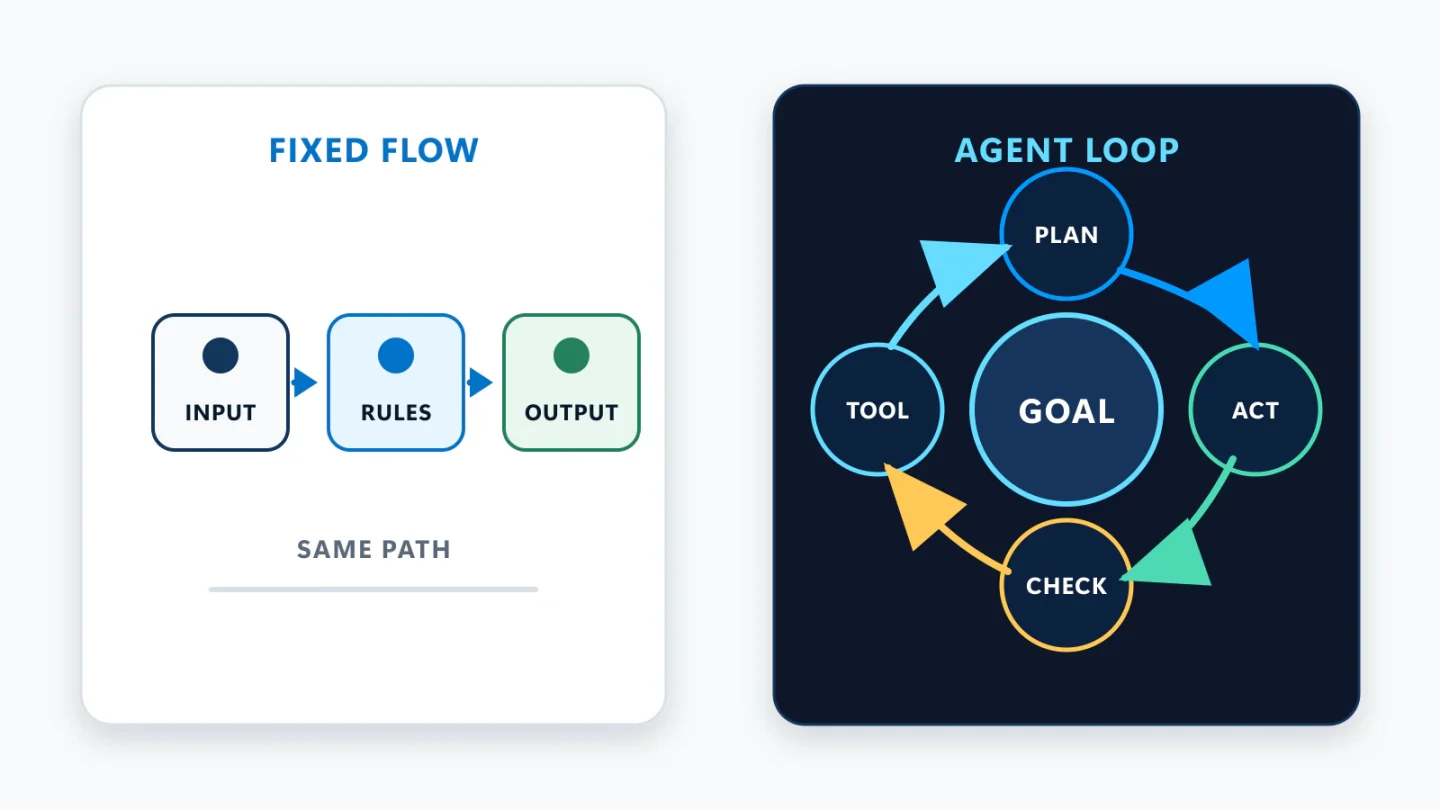
A reliable automation does not need to be intelligent. It needs to produce the right result, under known conditions, at an acceptable cost. AI becomes valuable when the work contains ambiguity that fixed rules cannot handle economically. An autonomous agent becomes justified only when the system must choose and sequence actions as conditions change.
That distinction matters because the most impressive demonstration is rarely the best production design. A model may complete a process end to end in a test, yet still be slower, more expensive, harder to audit, and less predictable than a conventional workflow. The practical question is not, “Can an agent do this?” It is, “Where does model judgment improve the workflow enough to justify the additional uncertainty and control burden?”
The short answer
Use the least autonomous design that can handle the real variability in the task:
- Use deterministic automation when inputs, rules, and acceptable outputs can be specified in advance.
- Add an AI step inside a controlled workflow when one part of the process requires classification, extraction, summarization, or drafting from unstructured information.
- Use an agent when the system must decide which tools to use, adapt its plan from intermediate results, and operate across paths that are impractical to enumerate.
- Require human approval when a proposed action is difficult to reverse, financially material, externally visible, privileged, or otherwise consequential.
These patterns are not competitors. A strong production system often combines all four: deterministic orchestration around a model-assisted decision, a narrowly scoped agent for exceptional cases, and an approval gate before a high-impact action.
Four patterns that are often called “automation”
1. Scripts and rule-based automation
A script receives known inputs and executes explicit instructions. Examples include renaming files, validating a form, rotating a log, copying an object after an event, or rejecting a request that fails a policy rule. Given the same relevant state, a well-designed deterministic automation should take the same path.
This is usually the best choice when correctness can be expressed as code. It is straightforward to unit test, inexpensive to run, and relatively easy to reason about during an incident. Its weakness is brittleness at the boundary: unexpected language, incomplete records, and changing document formats can create a growing collection of exceptions.
2. Deterministic workflows
A workflow engine adds state, branching, retries, timeouts, and error handling around deterministic tasks. It is appropriate for processes such as “receive order, validate inventory, request payment authorization, create shipment, and notify the customer.” The route may branch, but developers define the branches.
On AWS, for example, Step Functions can make transitions explicit and preserve an execution history. AWS guidance recommends rule-based orchestration for controlled processes and AI-native orchestration for natural-language interaction or flexible goal fulfillment. That is a useful boundary: known process state belongs in a state machine, not in a model’s conversation history.
3. AI-assisted workflows
An AI workflow keeps the control flow in code while assigning one bounded judgment task to a model. A support intake process might use a model to classify a free-form request, then pass the structured category and confidence score to conventional routing logic. A contract intake workflow might extract candidate dates and parties, then require validation before those values enter a system of record.
This pattern captures much of AI’s value without giving the model ownership of the process. It also creates clear test seams: teams can evaluate the model decision separately from the workflow’s business logic. For many organizations exploring AI advisory and consulting, this is the most productive first production pattern.
4. Autonomous or goal-directed agents
An agent receives an objective, evaluates context, chooses tools, observes results, and adjusts its next step. The developer defines the available capabilities and boundaries, but does not encode every route. This is useful for work such as investigating a multi-system incident, reconciling inconsistent technical records, or implementing a change across a large codebase where the next action depends on what the agent discovers.
Autonomy is a spectrum. An agent can be limited to research and recommendations, permitted to make reversible changes in a sandbox, or authorized to act in production. Treat those as different products with different risk reviews, not as settings to switch casually.
A practical decision matrix
| Question | Favors deterministic automation | Favors an AI workflow | Favors an agent |
|---|---|---|---|
| How variable are the inputs? | Structured and validated | Unstructured, but the required output is bounded | Unstructured and likely to change the plan |
| Can the path be enumerated? | Yes, with manageable branches | Mostly; one or two decisions need interpretation | No; tool choice and sequence depend on findings |
| What error rate is acceptable? | Very low and precisely testable | Some judgment error is acceptable if detected | Outcome can be reviewed, retried, or contained |
| How reversible are actions? | Any level, with normal controls | Prefer read-only or reversible actions | Prefer sandboxed and reversible; gate the rest |
| What must auditors understand? | Exact path and rule evaluation | Workflow path plus model input and output | Goal, plan, tool calls, policy decisions, and results |
If several rows point in different directions, the answer is usually a hybrid architecture rather than a compromise in the middle. Keep policy enforcement, money movement, state transitions, and retries deterministic. Use the model where language or context interpretation is genuinely necessary.
Seven selection criteria that survive the demo
1. Input variability
Start with actual inputs, including incomplete, contradictory, adversarial, and out-of-distribution examples. A task described as “route an email” may be simple until emails include forwarded threads, screenshots, multiple requests, or sensitive data. If a schema and validation rules can normalize the input reliably, conventional automation may still win. If interpretation is the hard part, a model-assisted step may be warranted.
2. Decision complexity
Count the decisions, not just the steps. A 20-step process with fixed transitions is a workflow. A three-step investigation where each observation changes the next tool can be agentic. Do not confuse length with intelligence.
3. Consequence and reversibility
Read-only research and draft generation have a different failure cost from deleting data, changing infrastructure, sending an external message, or approving a payment. Classify actions by consequence before choosing an autonomy level. A useful starting policy is:
- Low impact and easily reversible: allow within defined limits.
- Moderate impact or externally visible: generate a preview and request approval.
- High impact, privileged, regulated, or difficult to reverse: use deterministic controls and explicit authorization, even if an agent proposes the action.
4. Reliability target
“Works most of the time” is not a service objective. Define success at the task level and at every boundary: correct classification, valid tool arguments, completed downstream action, accurate final status, and safe handling of failure. A model can produce a plausible confirmation even when a tool failed, so the application must derive completion from trusted system responses rather than prose.
5. Latency and volume
Each model call and agent loop adds latency. At high volume, even a small per-run inference cost and a few additional seconds can dominate the business case. Batchable language tasks may still make sense, while interactive or transaction-heavy paths may require a deterministic fast lane and an AI exception path.
6. Change frequency
Agents are attractive when the environment changes faster than rules can be maintained, but that benefit is not free. The model, prompts, tools, and source data can all change behavior. If the business rule itself is stable and important, encode it. Use model reasoning to interpret facts for the rule, not to reinvent the rule on every run.
7. Evidence and auditability
Ask what evidence an operator will need after a wrong result. Deterministic systems can record state transitions and rule versions. AI systems also need model and prompt versions, retrieved context, tool requests, policy decisions, approvals, token usage, latency, and final outcomes. If the organization cannot retain this evidence appropriately, it is not ready to grant broad autonomy.
Calculate the full cost, not only model tokens
Inference is visible, but it is only one line in the operating cost. A fair comparison includes:
- model input and output usage, including repeated agent loops;
- retrieval, tool execution, storage, network, and observability;
- evaluation datasets and regression testing;
- human review time and approval delays;
- security engineering, access reviews, and incident response;
- maintenance when models, APIs, or connected systems change; and
- the cost of incorrect actions, missed work, and rework.
Traditional automation has design and maintenance costs too, especially when exception rules multiply. Compare the total cost per correctly completed outcome, not the cost per invocation. AWS’s agentic AI economics guidance similarly frames the decision around task suitability, risk impact, and return on investment rather than autonomy as a goal by itself.
Reliability improves when the architecture is deliberately boring
A robust hybrid design commonly looks like this:
- A deterministic service authenticates the user and validates the request.
- A workflow records state and selects the allowed operating path.
- A model interprets unstructured material or an agent investigates within a limited tool set.
- A policy layer validates proposed tool calls against identity, resource, action, and risk rules.
- High-impact actions pause for informed human approval.
- Deterministic code executes the approved operation, verifies the system response, and records the outcome.
This structure lets the AI recommend and adapt while normal software remains responsible for identity, authorization, state, and evidence. Bluegrass Cloud’s AI solutions and implementation work uses the same principle: controls and operating ownership are part of the implementation, not a cleanup step after the model works.
Security changes with authority
A chatbot that can only draft text has a limited blast radius. Connecting the same model to email, cloud consoles, customer records, or payment systems changes the threat model. Untrusted content can influence the model; a compromised tool can return malicious instructions; excessive credentials can turn a mistaken decision into a real incident.
At minimum, separate read and write tools, issue short-lived scoped credentials, restrict network destinations, validate tool arguments, protect secrets outside prompts, and log actions. Approval should show the exact action, target, important parameters, expected effect, and whether it can be reversed. A generic “allow agent?” dialog is not meaningful control. Teams handling sensitive environments should include cloud security and governance in the design review.
NIST’s Generative AI Profile is a useful reminder that risk management covers the entire lifecycle. A successful pilot does not establish production trustworthiness. Risks must be mapped, measured, managed, and governed as the system and its use change.
Example choices
Structured nightly data transfer
Files arrive in a known schema, validation rules are explicit, and failed records must be quarantined. Use deterministic automation. An LLM adds cost and uncertainty without solving a missing capability.
Inbound request triage
Messages arrive in natural language, but the only desired output is a category, priority suggestion, and extracted identifiers. Use an AI-assisted workflow. Keep assignment rules and notifications deterministic, and route low-confidence results to a person.
Infrastructure incident investigation
The system must inspect alerts, logs, recent deployments, and service dependencies, with each observation changing the next query. A read-only agent can be appropriate. Let it gather evidence and propose remediation; require approval and normal change controls before production modification.
Issuing refunds
A model can summarize the case and recommend an outcome, but eligibility, amount limits, separation of duties, and the transaction itself should remain behind deterministic policy. Approval may be required based on amount or exception type. “Agentic” should not mean bypassing financial controls.
A disciplined pilot plan
- Map the current work. Document inputs, decisions, systems, exceptions, owners, and failure consequences.
- Establish a non-AI baseline. Measure current accuracy, cycle time, rework, and operating cost.
- Choose the minimum autonomy. Start with read-only or draft-only behavior and a narrow tool set.
- Build an evaluation set. Include routine, difficult, malformed, sensitive, and adversarial examples.
- Run in shadow mode. Compare recommendations with real outcomes without allowing the system to act.
- Introduce bounded action. Add approvals, limits, rollback, alerts, and a kill switch before increasing scope.
- Review the economics. Measure correct outcomes, human effort, latency, model usage, and failure cost.
A pilot should be able to conclude that deterministic automation is the better answer. That is not a failed AI project; it is a sound architecture decision.
Recommended approach
Begin with the business decision and the operational boundary. Encode stable rules in software. Insert AI only where language or contextual judgment provides measurable value. Allow autonomy only where adaptive tool use is necessary, observable, and contained. Then increase authority in small, evidence-based steps.
If you need to assess a workflow, define an appropriate autonomy level, or design the production controls around it, contact Bluegrass Cloud with the process, systems, users, and outcome involved.