
Reviewed: August 2026.
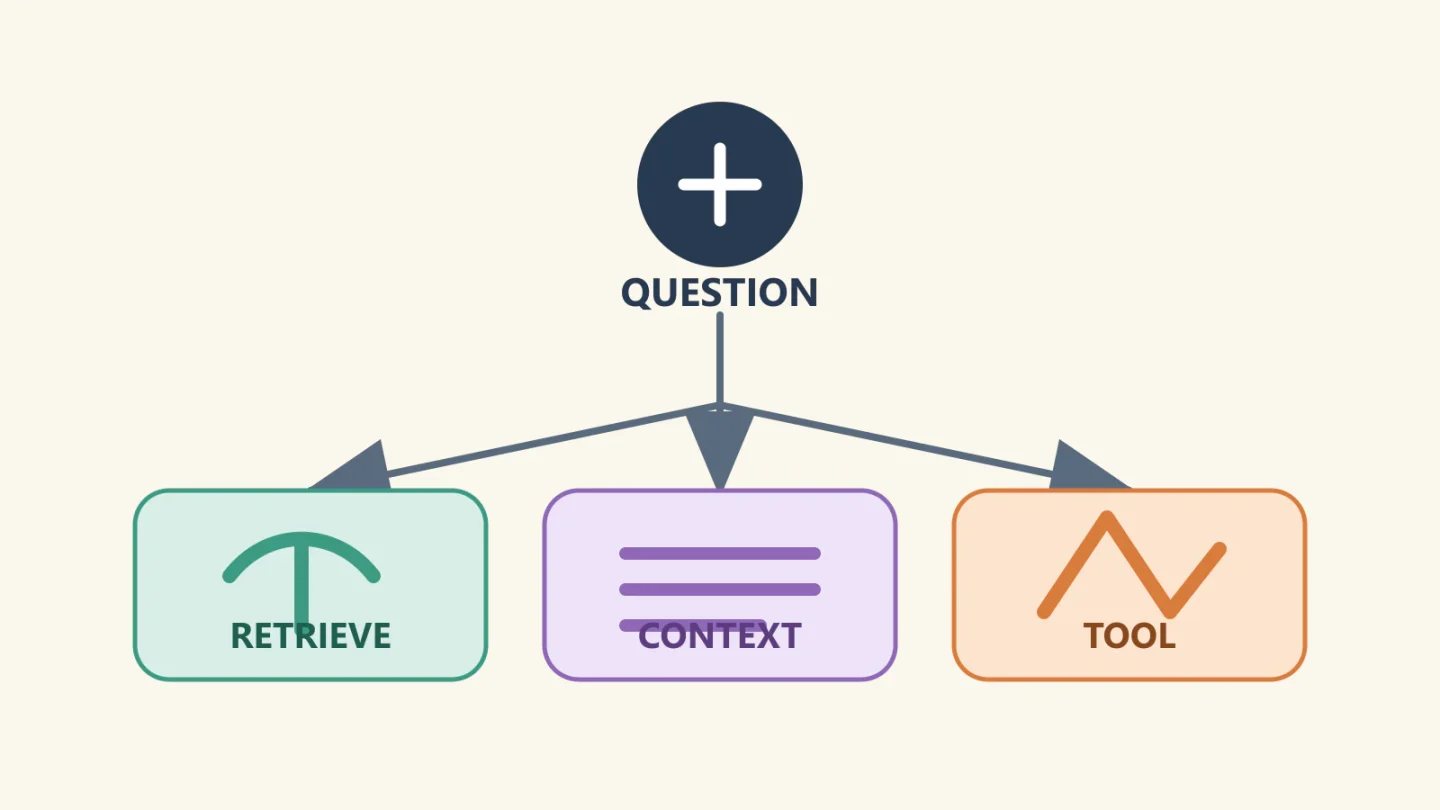
Retrieval-augmented generation, long-context prompting, and tool use are often presented as competing ways to give an AI system more knowledge. They are not interchangeable. Each solves a different problem: long context gives a model a bounded working set, RAG finds relevant evidence in a larger collection, and tools read or change authoritative systems at request time.
The practical question is therefore not “Which technique is best?” It is “What kind of truth does this request require, how fresh must it be, and is the model only explaining information or also acting on a system?” The answer frequently produces a hybrid architecture, but a hybrid should be earned by requirements rather than assembled from every available component.
The short decision
- Use long context when the complete, relevant working set is known at request time and fits comfortably within the selected model’s supported context. Contract review, comparison of a handful of proposals, and summarization of a meeting packet are good candidates.
- Use RAG when the knowledge corpus is larger than a practical prompt, changes independently of application releases, or needs document-level citations and access filtering. Policies, technical documentation, and a large support library fit this pattern.
- Use tools when the answer depends on live structured state or the system must perform an operation. Order status, current inventory, ticket creation, and deployment approval belong behind authenticated APIs, not in an embedding index.
- Combine them when one request crosses those boundaries. An assistant might retrieve a refund policy, call an order API, and use a small long-context packet containing the conversation and the retrieved evidence to draft a response.
Before adding any of these mechanisms, define the source of truth. A model’s trained parameters are not an operational database, a vector index is not automatically current, and a large prompt does not turn untrusted text into trusted instructions.
Start with the kind of knowledge, not the model
Useful AI applications generally draw from four different knowledge layers. The model supplies broad language and reasoning capability. The request supplies immediate user intent. Retrieved documents supply selected evidence. Tools supply live state and controlled actions. Treating those layers explicitly makes architecture decisions easier to review and test.
Consider the question, “Can this customer receive a refund today?” The policy library explains eligibility rules, so RAG may locate the governing policy and its effective date. The order service contains purchase date, payment status, and prior adjustments, so a read-only tool should fetch those values. The current conversation and a short policy excerpt can fit in context. If the user then asks to issue the refund, a separate write tool and an approval rule are required. No amount of extra context replaces that authorization boundary.
This separation is also useful when planning an AI solution implementation. Teams can assign ownership to the content pipeline, operational APIs, prompt assembly, access policy, and evaluation suite instead of treating “the AI” as one opaque component.
Long context: a deliberate working set
For a small, bounded packet, long context is often the simplest option operationally. The application sends the relevant documents, instructions, examples, and conversation history in one model request. There is no retrieval index to build, synchronize, or tune. The model can compare details across the supplied material without losing the surrounding structure that chunking may remove.
That simplicity is valuable when the corpus is small and bounded. A due-diligence assistant reviewing twelve files uploaded for one transaction may benefit from seeing all twelve together. A coding assistant diagnosing a specific failure may need the stack trace, the affected source files, and the deployment configuration in one request. A board-packet summarizer can work from the packet itself rather than from a persistent knowledge base.
Long context still has limits beyond the published token ceiling:
- Every included token can add latency and inference cost, even when most of the material is irrelevant to the question.
- Repeated boilerplate and conflicting versions can distract the model. “It fits” is not evidence that it helps.
- The application must decide which material is trustworthy and current before it enters the prompt.
- A context window is temporary working memory. It is not a governed document repository, durable application memory, or a replacement for system-of-record queries.
Use a clear document envelope with source name, revision, date, and access scope. Put stable system instructions outside user-supplied material. Delimit documents so their contents cannot be confused with application instructions, and ask the output to identify which supplied source supports important conclusions. Even when everything fits, evaluate shorter curated packets against the full packet. The smaller option may be faster, less expensive, and more accurate.
RAG: search before generation
RAG adds a retrieval step before inference. During ingestion, documents are parsed, split into chunks, represented for search, and stored with metadata that points back to the source. At request time, the application searches for relevant passages, optionally filters or reranks them, and adds the selected evidence to the model prompt. AWS documents this same basic sequence for Amazon Bedrock Knowledge Bases: preprocess content, create embeddings, retrieve related chunks, and augment the prompt.
RAG is a strong fit when users ask many questions across a corpus that is too large or too dynamic to send in full. It can return a focused evidence set and preserve links to the documents used. Metadata filters can enforce boundaries such as tenant, department, jurisdiction, product version, or effective date before generation.
The difficult part is retrieval quality, not the vector database brand. A weak RAG system can confidently answer from the wrong revision or retrieve a passage that contains the right terms but lacks the needed exception. Important design choices include:
- Parsing: tables, headings, footnotes, scanned pages, and diagrams should retain enough structure to remain meaningful.
- Chunking: chunks need sufficient local context without becoming so broad that search results contain mostly noise.
- Metadata: owner, document type, revision, effective date, tenant, and sensitivity often matter as much as semantic similarity.
- Retrieval: keyword, semantic, hybrid, filters, and reranking should be selected with real queries rather than defaults.
- Freshness: ingestion success, deletion, superseded versions, and source permissions need observable synchronization behavior.
- Abstention: the application needs a defined response when evidence is missing, conflicting, stale, or below a useful relevance threshold.
RAG does not automatically make an answer true. It narrows the evidence available to the model. The team still needs retrieval tests, answer-quality tests, citation checks, and content governance. Bluegrass Cloud’s AI advisory and consulting work can help define those requirements before an implementation commits to a retrieval platform.
Tool use: query or change the authoritative system
A tool is an application capability exposed to the model through a controlled interface. The model can propose a function call with structured arguments; application code validates the call, authorizes it, executes the underlying API, and returns a result. Tools may be read-only, such as “get invoice status,” or mutating, such as “open a support ticket.”
Tool use is the correct choice when authoritative operational state or exact structure matters. Indexing yesterday’s inventory in a RAG store is inferior to querying the inventory service that owns today’s count. Sending a spreadsheet export in long context is inferior to calling a reporting API when users need a reconciled balance. Likewise, an assistant cannot complete a business workflow merely by describing an action; the application must invoke an authorized system. A live API can still return cached or eventually consistent data, so document its freshness and consistency contract rather than treating “live” as synonymous with “current.”
Tool output should be treated as data, not as new instructions. A ticket description, web page, or CRM note may contain text that attempts to redirect the model. Keep tool definitions narrow, validate every argument, bind authorization to the authenticated user and resource, and separate read operations from writes. High-impact writes should stop at an approval gate with the proposed action and exact parameters visible to the reviewer.
Schema-constrained function arguments improve interface reliability, but schema validity is not business authorization. A valid request to transfer 10,000 units is still invalid if the user may transfer only 100. The service behind the tool must enforce those rules regardless of what the model proposes.
A comparison that exposes the real tradeoffs
| Decision factor | Long context | RAG | Tool use |
|---|---|---|---|
| Best source | Known request-specific files | Large document collection | Live system of record |
| Freshness model | As current as the selected material when the prompt is assembled | As current as indexed content after synchronization | As current as the source system, cache, and API consistency model when called |
| Primary complexity | Prompt assembly and token management | Parsing, indexing, retrieval, and citations | Authentication, authorization, validation, and failure handling |
| Traceability | Source packet can be retained | Chunk-to-source citations | API request, result, and audit event |
| Can perform actions | No | No | Yes, if explicitly implemented |
| Common failure | Too much irrelevant material | Wrong or stale evidence retrieved | Overbroad permission or unsafe side effect |
Cost comparisons must include the entire path. Long context consumes input tokens repeatedly. RAG adds ingestion, storage, retrieval, and often reranking, while reducing prompt size. Tools add API traffic, integration maintenance, and sometimes human review. Measure cost per completed, acceptable task, not only cost per model call.
Three practical architecture patterns
1. Bounded analysis
A user uploads a contract and two amendments. The application checks file type and access, extracts the text, labels each document, and sends the set with the review instructions. The result cites sections within the supplied packet. Long context is appropriate because the user has already selected the complete working set and no external action is requested.
2. Governed knowledge assistant
An employee asks about an internal security standard. The application authenticates the employee, converts identity claims into retrieval filters, searches only authorized and current policy content, reranks the results, and asks the model to answer from that evidence. If the evidence is inadequate, the assistant points to the policy owner rather than improvising. This is primarily RAG.
3. Service assistant with evidence and live state
A customer asks why an order cannot be returned. Retrieval provides the current return policy. A read tool obtains order date, category, and fulfillment status. The model explains how the policy applies. If the customer asks to start a return, the application validates eligibility again in deterministic code, displays the proposed change, obtains any required approval, and invokes a narrow write tool. This pattern uses all three mechanisms, but each has a distinct job.
Build the router before adding more knowledge
Hybrid systems need explicit routing. Do not leave every decision to an unconstrained model. Some routes are deterministic: questions containing an order identifier must query the order service; requests about formal policy must retrieve an effective policy version; write operations must enter an approval workflow. The model can classify ambiguous intent inside those fixed boundaries.
A useful request plan records:
- the user and tenant;
- the task and its risk tier;
- the permitted knowledge sources and tools;
- freshness and citation requirements;
- whether the request is read-only, proposes a change, or executes a change;
- the maximum context and retrieval budget;
- the conditions that require abstention or human review.
This plan is a policy decision made by the application. The resulting prompt is only one implementation detail.
Evaluate each layer independently
An end-to-end “helpfulness” score cannot explain why a system failed. Keep test sets that isolate the layers:
- Context tests check whether the answer follows supplied documents, notices conflicts, and cites the correct passage.
- Retrieval tests measure whether the required source appears in the candidate set and whether filters exclude forbidden or obsolete content.
- Tool-selection tests verify when a tool should and should not be proposed, along with argument accuracy.
- Authorization tests prove that a tool executor rejects another tenant’s resources, excessive values, and unapproved writes even when arguments are well formed.
- End-to-end tests measure task completion, groundedness, latency, cost, abstention, and reviewer workload on representative cases.
Log source identifiers, retrieval scores, tool names, validation outcomes, model and prompt versions, token usage, latency, and final disposition. Avoid placing sensitive document text or tool results in logs by default. A governed logging design is part of cloud security and governance, not a cleanup task after launch.
A sensible implementation sequence
- Choose one bounded task and define acceptable outputs, prohibited behavior, and the authoritative sources.
- Establish a long-context baseline with a small curated packet. This reveals whether retrieval is actually necessary.
- If the corpus is too large or dynamic, add retrieval and test it separately before tuning generation.
- If current state is required, add a read-only tool with narrow permissions and deterministic validation.
- Add write tools only after approval, audit, idempotency, and rollback behavior are designed.
- Compare the simplest passing architecture with more complex variants using the same evaluation set.
The best knowledge architecture is rarely the one that can access the most information. It is the one that supplies the smallest sufficient set of trustworthy evidence and capabilities for the task, while making freshness, permission, and failure visible. If your team needs to turn that decision into an operating design, contact Bluegrass Cloud with the use case, source systems, and risk constraints.