
Reviewed: August 2026.
The Amazon Bedrock playground answers an important first question: can a model produce a useful response for a representative prompt? Production begins with the questions the playground does not answer. Which workload identity may invoke which model? Where can requests be processed? What is logged? How does the application behave during throttling, a model change, unsafe output, or an evaluation regression? Who owns cost, incident response, and rollback?
This is an operations guide for the stage after a demo works. It does not repeat a step-by-step agent build. The focus is the production control plane around inference: stable application contracts, least-privilege IAM, inference profiles, privacy-aware logging, evaluation gates, bounded retries, quotas, guardrails, observability, and change management.
A production request path
A typical production path contains more than an application and a model:
- The edge authenticates the user, applies request-size limits, and assigns a correlation ID.
- The application authorizes the use case and retrieves only permitted context.
- Prompt assembly separates trusted instructions from user and retrieved content.
- An input policy checks data classification, injection indicators, required fields, and use-case limits.
- A workload role calls the Bedrock Runtime endpoint through a selected model or inference profile.
- The application validates stop reason, output structure, citations or tool arguments, and business rules.
- High-impact actions enter a separate approval and tool-execution path.
- Telemetry records request metadata, latency, token use, errors, evaluation signals, and final disposition without leaking sensitive content.
Each stage should fail predictably. If context retrieval is unavailable, the application may abstain rather than ask the model to answer from memory. If output validation fails, the user should receive a controlled error or safe fallback. If a tool call is proposed, the target service must authorize it independently of the model.
Replace playground identity with a workload identity
Console experimentation often runs under a broad human identity. Production should use an IAM role attached to the compute service, with no embedded AWS access keys. Separate application invocation roles from administrative roles that enable models, configure logging, create guardrails, run evaluations, or change inference profiles.
Access to some Bedrock serverless models may involve a one-time AWS Marketplace enablement step. AWS currently documents automatic enablement on first invocation when the caller has the required Marketplace permissions, with separate handling when it does not. Do not grant Marketplace subscription permissions to every runtime role simply to make initial testing convenient. Complete the one-time enablement under controlled administration, then let the application role invoke only the approved resources.
The Converse API uses the bedrock:InvokeModel action; streaming also requires bedrock:InvokeModelWithResponseStream. Scope permissions to the selected model or inference profile resources. A cross-Region profile may require permission to the profile and the foundation model resources in every destination Region. Enumerate the Regions allowed by governance rather than copying a wildcard policy.
{
  "Version": "2012-10-17",
  "Statement": [
    {
      "Sid": "InvokeApprovedInferenceProfile",
      "Effect": "Allow",
      "Action": "bedrock:InvokeModel",
      "Resource": [
        "arn:aws:bedrock:us-east-1:123456789012:inference-profile/PROFILE_ID",
        "arn:aws:bedrock:us-east-1::foundation-model/MODEL_ID",
        "arn:aws:bedrock:us-east-2::foundation-model/MODEL_ID",
        "arn:aws:bedrock:us-west-2::foundation-model/MODEL_ID"
      ]
    }
  ]
}
Those are placeholders, not a paste-ready list. Use GetInferenceProfile and the current model documentation to identify actual destinations, then reconcile IAM with AWS Organizations service control policies. AWS warns that blocking any required destination Region can make the cross-Region request fail. If data residency requires a geography-bounded profile, do not substitute a global profile merely for more capacity.
Connect these decisions to the organization’s cloud security and governance model, including account boundaries, role ownership, policy review, and incident disablement.
Choose a model with a workload evaluation, not a chat impression
Model selection should begin with the task and acceptance criteria. Build a representative dataset before comparing candidates. Include normal cases, edge cases, adversarial inputs, long inputs, multilingual content if relevant, empty or conflicting context, tool-selection cases, and prompts that should be refused or escalated.
Evaluate at least:
- task correctness and completeness;
- groundedness and citation accuracy when retrieval is used;
- tool choice and argument validity;
- instruction following and output-schema adherence;
- safety and sensitive-data behavior;
- latency, time to first token, and timeout rate;
- input and output token use;
- regional availability, inference mode, and quota behavior;
- cost per acceptable completed task.
Do not collapse the result into one average. A model that scores well overall but fails a critical authorization scenario is not acceptable for that workflow. Segment results by risk and user population. Preserve examples and evaluator instructions so a future model or prompt change can run against the same baseline.
Amazon Bedrock supports model and RAG evaluation capabilities, including automated and human-based approaches for supported resources. Platform evaluation can supplement, but not replace, an application-specific test harness that knows your schemas, policies, and business outcomes.
Put a stable application contract in front of the model
Bedrock supports several inference API patterns. For multi-model conversational applications, the Converse API provides a common message interface across supported models. The Invoke API gives direct access to model-specific request and response bodies. Select one deliberately and hide provider-specific differences behind an internal service boundary.
The rest of the application should request a capability, not scatter a model ID throughout business code. A configuration record can map support-summary-production to an approved inference profile, prompt version, maximum output, guardrail version, timeout, and fallback policy. Changes then pass through review and evaluation without a code search across every caller.
Pin model and prompt versions where the service supports explicit identifiers. A silent alias change makes evaluation and incident reconstruction difficult. When a provider announces a lifecycle change, qualify the successor against the existing dataset, canary it, and retain a tested rollback path.
A bounded Converse client
This Python example uses the runtime role’s normal AWS credential chain, standard SDK retries, explicit timeouts, input and output limits, request metadata, and metadata-only logging. It does not log prompt or response text. Replace the profile identifier and Region through deployment configuration.
import json
import logging
import os

import boto3
from botocore.config import Config
from botocore.exceptions import ClientError

AWS_REGION = os.environ["AWS_REGION"]
INFERENCE_PROFILE_ID = os.environ["BEDROCK_INFERENCE_PROFILE_ID"]
MAX_INPUT_CHARACTERS = 20_000

logger = logging.getLogger()
logger.setLevel(logging.INFO)

bedrock = boto3.client(
    "bedrock-runtime",
    region_name=AWS_REGION,
    config=Config(
        connect_timeout=3,
        read_timeout=45,
        retries={"mode": "standard", "total_max_attempts": 4},
    ),
)


def generate_summary(source_text, request_id):
    if not source_text or len(source_text) > MAX_INPUT_CHARACTERS:
        raise ValueError("source_text is empty or exceeds the application limit")

    try:
        result = bedrock.converse(
            modelId=INFERENCE_PROFILE_ID,
            system=[
                {
                    "text": (
                        "Summarize only the supplied source. "
                        "If the source is insufficient, say so."
                    )
                }
            ],
            messages=[
                {
                    "role": "user",
                    "content": [{"text": source_text}],
                }
            ],
            inferenceConfig={
                "maxTokens": 600,
                "temperature": 0.1,
            },
            requestMetadata={
                "application": "document-summary",
                "environment": "production",
                "request_id": request_id,
            },
        )
    except ClientError as error:
        error_code = error.response.get("Error", {}).get("Code", "Unknown")
        logger.warning(
            json.dumps(
                {
                    "event": "bedrock_request_failed",
                    "request_id": request_id,
                    "error_code": error_code,
                }
            )
        )
        raise

    stop_reason = result.get("stopReason")
    content = result["output"]["message"]["content"]
    text_blocks = [block["text"] for block in content if "text" in block]
    if stop_reason != "end_turn" or not text_blocks:
        raise RuntimeError(f"unexpected model result: {stop_reason}")

    usage = result.get("usage", {})
    logger.info(
        json.dumps(
            {
                "event": "bedrock_request_succeeded",
                "request_id": request_id,
                "stop_reason": stop_reason,
                "input_tokens": usage.get("inputTokens"),
                "output_tokens": usage.get("outputTokens"),
                "latency_ms": result.get("metrics", {}).get("latencyMs"),
            }
        )
    )
    return "\n".join(text_blocks)
The client is only one layer. The API edge must enforce its own body limit before loading input into memory. Callers need a controlled mapping from exceptions to user responses. The returned summary still needs application-specific output checks. If the workflow accepts documents from users, treat document text as untrusted data and keep it separated from system instructions.
Standard retries are appropriate only for failures the SDK classifies as transient. Keep the attempt count bounded and the overall deadline below the caller’s timeout. A retry that completes after the user has abandoned the request still consumes capacity and cost.
Secrets and network design
A Bedrock runtime call from an AWS workload normally uses IAM role credentials; it does not require an API key stored in an environment variable. Keep third-party API keys, database credentials, and other secrets in a managed secret store, grant read access only to the workload that needs them, and rotate according to the owning system.
Prompt templates, model IDs, and inference settings are configuration, not necessarily secrets, but they still need version control and change review. Environment variables are appropriate for non-sensitive identifiers when deployment history and access meet the requirement. Do not place customer data or large prompt templates in environment variables.
Decide whether workloads require private connectivity and an AWS data perimeter based on the threat model. Align VPC endpoints, endpoint policies, resource controls, organization policies, and allowed Regions. Adding a VPC does not automatically improve security; it also introduces routing, DNS, endpoint, and cost considerations that need operational ownership.
Logging requires a privacy decision
Amazon Bedrock model invocation logging is disabled by default. When enabled for supported runtime operations, it can deliver invocation metadata and selected request and response data to CloudWatch Logs or S3. That can be valuable for diagnosis and evaluation, but full prompts and outputs may contain personal, confidential, regulated, or security-sensitive material.
Before enabling content logging, define:
- which applications and Regions are covered;
- whether prompt and response content may be retained;
- redaction or tokenization before inference and before logging;
- log destination, encryption, access, retention, deletion, and legal hold;
- who may search content and for what purpose;
- how sampled content is separated from general operational telemetry;
- how delivery failures are detected.
Application logs should default to metadata: correlation ID, use case, profile, prompt version, token counts, latency, stop reason, retry count, validation result, and error class. Never log AWS credentials, authorization headers, full tool results, or secret values. Use request metadata to correlate supported invocation logs without embedding customer content in identifiers.
Observe service health and application quality separately
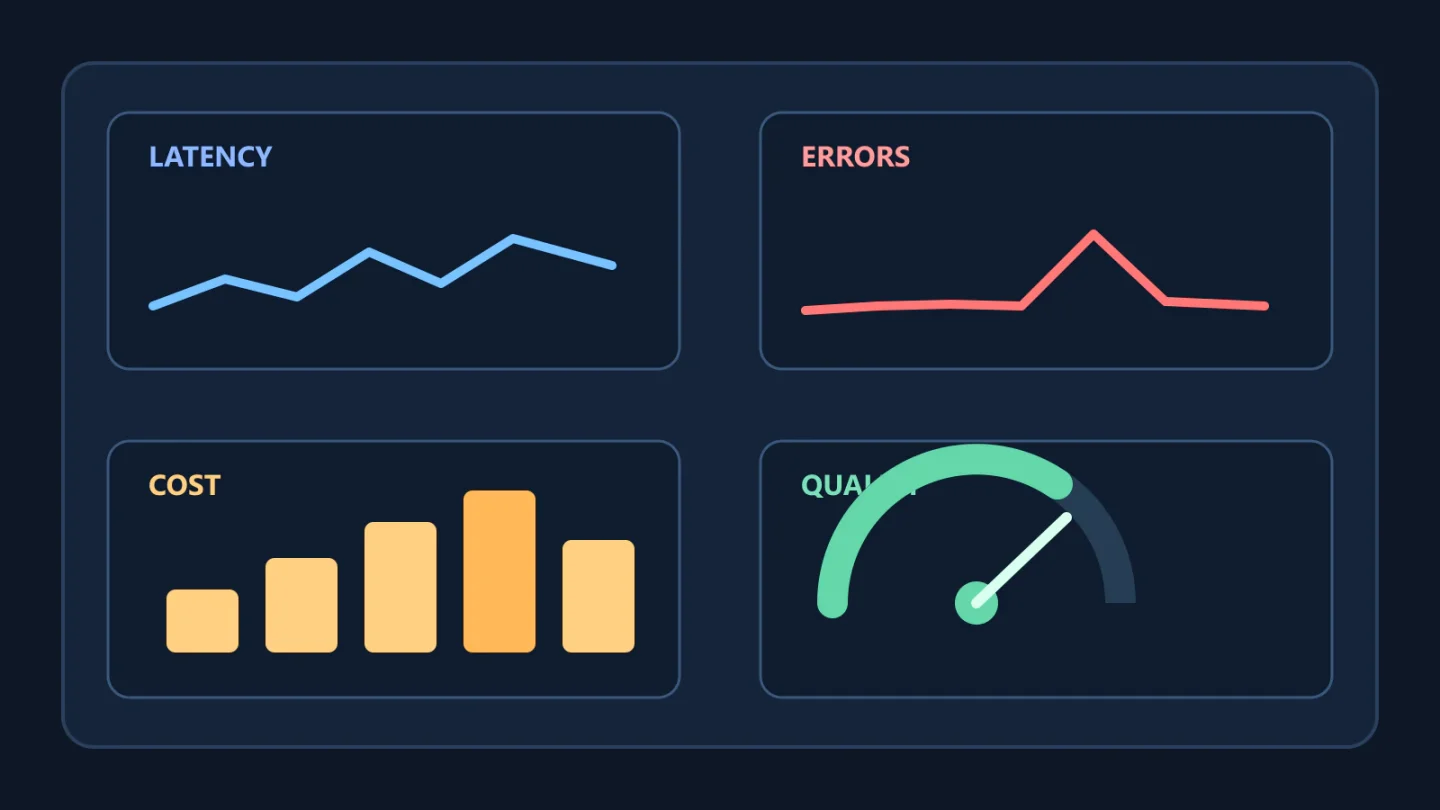
The AWS/Bedrock CloudWatch namespace exposes runtime measures such as invocations, latency, client errors, server errors, throttles, input tokens, output tokens, and time to first token for supported streaming operations. Alarm on error and throttle rates, tail latency, and token anomalies by the dimensions meaningful to the application.
Service health does not reveal answer quality. Add application measures:
- schema-validation failure rate;
- retrieval abstention and citation-verification rate;
- tool-call rejection and approval rate;
- user correction, escalation, or task-abandonment rate;
- sampled evaluation score by prompt and model version;
- cost and latency per accepted task;
- policy and guardrail intervention rate.
Correlate, but do not confuse, the two planes. A latency incident may require capacity or retry changes. A groundedness regression with normal latency requires prompt, retrieval, model, or content investigation. Assign runbooks and owners for both through a defined managed cloud operations model.
Plan quotas and backpressure before traffic
Bedrock inference is governed by model- and endpoint-specific quotas, including token-based limits and, for some paths, request-based limits. New accounts can have different effective limits, and supported models and profiles change. Check Service Quotas in the actual source Region and account rather than copying a number from an article.
Load-test representative prompt sizes and output limits. A request budget based only on requests per second ignores that a small classification and a long generation consume different token capacity. Control input length and maxTokens; unbounded output is a capacity and cost risk.
When demand exceeds capacity:
- reject or queue work before saturating the inference dependency;
- use bounded retries with jitter for throttling and transient server errors;
- apply per-tenant and per-use-case concurrency limits;
- degrade optional features before critical workflows;
- use an approved cross-Region profile only when its data-routing behavior fits policy;
- consider provisioned capacity for workloads whose stability and economics justify it.
Do not retry validation errors, access denials, unsupported model requests, or oversized input. Those require a code, configuration, or user correction. Monitor queue age and caller timeouts so work does not become stale while waiting.
Use inference profiles for routing and attribution
System-defined cross-Region inference profiles route a model request across supported Regions to improve available throughput. Geography-bounded and global profiles have different routing implications. Review the current destination list, IAM and organization-policy requirements, and data-residency obligations before selection.
Application inference profiles can wrap a model or cross-Region profile and attach cost-allocation tags for usage attribution on supported runtime APIs. Use a profile per meaningful application or workload boundary rather than one undifferentiated company profile. Activate cost-allocation tags before expecting them in billing reports; tagging is not retroactive.
An inference profile is not a business fallback policy. If the chosen model is unavailable or fails evaluation, the application needs an explicit response. Switching to a different model can change schemas, tool behavior, latency, safety, and output quality. Prequalify any fallback and record which model handled each request.
Guardrails are one layer, not authorization
Amazon Bedrock Guardrails can evaluate inputs and outputs using configured policies such as content, denied-topic, sensitive-information, and word filters. Apply a versioned guardrail where it matches the use case and test both overblocking and underblocking with representative data.
A guardrail does not decide whether a user may read another customer’s record, issue a refund, or deploy production. Identity, retrieval filters, tool permissions, deterministic validation, and human approval remain application responsibilities. A response that passes a content filter can still be factually wrong or unauthorized.
Record guardrail version and intervention reason without exposing sensitive content. Alarm on sudden changes in intervention rate, which may signal an attack, a traffic shift, a prompt regression, or a guardrail update that needs review.
Control cost without degrading the task blindly
Track input and output tokens, calls, guardrail use, retrieval and reranking, storage, logs, and supporting compute by application. Use application inference profiles and tags where supported, AWS Budgets, anomaly detection, and per-tenant quotas. Cost per request is useful; cost per acceptable completed task is better.
Practical controls include trimming repeated boilerplate, retrieving smaller relevant evidence sets, setting task-specific output limits, using a smaller qualified model for simpler work, caching only where correctness and privacy allow it, and rejecting accidental oversized inputs at the edge. Do not reduce context until the model loses the evidence it needs, or route high-risk work to a cheaper model that has not passed the evaluation.
Model invocation content logs can themselves become a material cost and data-retention burden. Set log levels and retention intentionally, and query sampled periods rather than scanning unlimited history.
Build an evaluation and release loop
- Version the prompt, model or profile, tool schema, retrieval configuration, guardrail, and output validator.
- Run offline regression tests on every material change.
- Require human review for critical failure categories and sampled qualitative cases.
- Deploy to a nonproduction environment with production-like IAM and quotas.
- Canary a small, eligible share of traffic and compare quality, latency, safety, and cost.
- Promote only when explicit thresholds pass.
- Retain the prior configuration and a tested rollback mechanism.
- Feed production corrections and novel failures into the evaluation set after privacy review.
A model change is an application change even when no application code changes. Give it the same traceability expected for a dependency or configuration release.
Runbooks and kill switches
Prepare responses for throttling, elevated latency, model access failure, quota exhaustion, bad deployment, quality regression, prompt injection campaign, sensitive-data exposure, runaway spend, and invocation-log delivery failure. Each runbook should identify dashboards, owner, immediate containment, customer response, evidence preservation, and recovery criteria.
Useful kill switches include disabling one application route, denying a specific inference profile to the runtime role, reducing allowed concurrency, turning off a privileged tool, forcing read-only mode, and reverting the prompt/model configuration. Test these controls. An emergency mechanism that exists only in a design document is not an operational control.
The production readiness review
Before launch, require clear answers to these questions:
- Which identity invokes Bedrock, and which exact resources may it invoke?
- Which Regions may process data, including every inference-profile destination?
- What input is prohibited, redacted, or retained?
- Which evaluation cases and thresholds block release?
- What retries, timeouts, concurrency limits, and backpressure apply?
- Which quotas have been verified under load?
- What does the guardrail cover, and what remains application policy?
- Which service and quality alarms wake an owner?
- How is cost attributed and bounded?
- How can the team disable or roll back the workload?
The transition from demo to production is the transition from an interesting response to an owned service. Bluegrass Cloud’s AI solutions and implementation work can help establish that service boundary, while cloud strategy and architecture can align it with accounts, Regions, identity, networking, and operations. To review a working Bedrock prototype, share the use case, current request path, data classification, and release owner.
Sources and further reading
- AWS: Inference using the Amazon Bedrock Converse API
- AWS: Set up model invocation resources using inference profiles
- AWS: Monitor model invocation using CloudWatch Logs and S3
- AWS: Monitor Bedrock Runtime inference using CloudWatch metrics
- AWS: Quotas for the Bedrock Runtime endpoint
- AWS: How Amazon Bedrock Guardrails works
- AWS: Evaluate the performance of Amazon Bedrock resources